

Smale's mean value conjecture (Smale 1981) asserts that, for every complex polynomial  of degree at least 2 and every point
 with
 ,
some critical point
 of
 satisfies
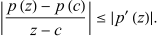 |
Smale (1981) proved the weaker inequality with right side  . A stronger proposed constant for degree
 is
 . Unlike the real mean
value theorem, the statement compares a secant quotient with a derivative
at the prescribed point and selects the other endpoint among the critical
points.
Adamczewski (2026) released a proposed counterexample to the constant 1, constructed autonomously by GPT-6 Astra. The claimed polynomial
satisfies  and
 , but
 at every critical
point. A Lean proof was checked against an independently
supplied formal statement with only standard logical axioms. Independent mathematical
review of the construction had not been reported as of Sep. 7, 2026 (VibeMathed
2026).
Jatar and Ng (2026) report the stronger lower bound
 |
where  is the supremum, over complex
polynomials
 of polynomial degree
at least two with
 and
 ,
of
 . They obtain
 by reformulating the problem using univalent
functions and Blaschke products, and also
obtain this lower bound in every sufficiently large polynomial
degree. Jatar and Ng (2026) used GPT-6 Astra and Grok 4.6 for numerical experiments
and preliminary draft proofs, which the authors state they
verified, simplified, and rewrote.
Adamczewski and Colbrook (2026) gave a geometric construction and human exposition of counterexamples. Their explicit polynomial
in  has polynomial degree 29984, satisfies
 and
 , and obeys
 , certified
by interval arithmetic. A small leading-term perturbation gives counterexamples in
every polynomial degree
 . This supplies explicit finite-degree examples,
while the larger lower bound of Jatar and Ng (2026) concerns the value of
 .
