


A single-track Gray code of length  and period
 is a cyclic sequence of
 distinct binary words of length
 such that consecutive words, including
the last and first, differ in exactly one bit and every column
is a cyclic shift of one fixed column (Hiltgen et al. 1996, Dzoba 2026). It
is therefore a Gray code with an additional column-shift
condition, not necessarily a listing of every binary word.
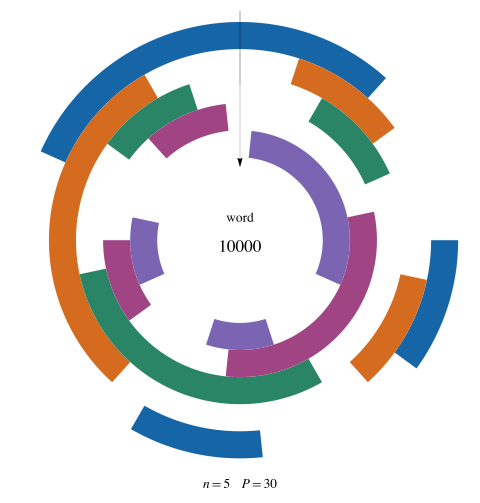
The figure shows a length-5 code of period 30 using five concentric annuli. Colored portions represent 1 and uncolored portions represent 0. Reading along the pointer from the outer annulus inward gives a five-bit word. Moving the pointer clockwise through successive equally spaced positions changes exactly one bit, including the last-to-first step. Each annulus displays the same binary pattern up to rotation. A physical single-track encoder can instead read one such pattern using five sensors at the corresponding angular offsets (Dzoba 2026). The ring display is based on code supplied by E. Pegg, Jr. (pers. comm., Oct. 23, 2026).
For odd prime  , the largest possible period is
at most
 . Dzoba (2026) constructed codes attaining this
upper bound for every odd prime
 . For
 , explicit codes were checked
word by word. For
 , 43, and 47, the constructions
use a proved implication from the Degni-Drisko adjacency property, which was checked
computationally at those lengths. This property orders nonconstant necklaces
by their first occurrences in the binary reflected Gray
code and requires consecutive necklaces to have
representatives at Hamming distance 1. Existence
for every odd prime follows conditionally from that property
and is not proved in general.
Dzoba (2026) reports that Claude performed the searches, found the closing pivots, and wrote the proofs and Lean formalization under the author's direction. Codex supplied additional verification programs.
