TOPICS
Search

Shanks' Transformation


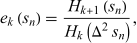
Shanks' transformation is a nonlinear transformation of a sequence that generalizes Aitken's delta-squared process (Shanks 1955). For a positive integer k, it maps s_n, ..., s_(n+2k) to

 e_k(s_n)=(H_(k+1)(s_n))/(H_k(Delta^2s_n)),

provided the denominator is nonzero. Here Deltas_n=s_(n+1)-s_n is the forward difference, and the determinant of the j×j Hankel matrix is

 H_j(u_n)=det([u_(n+r+t)]_(r,t=0)^(j-1)).

For k=1, this gives e_1(s_n)=s_n-(s_(n+1)-s_n)^2/(s_(n+2)-2s_(n+1)+s_n), the forward-indexed form of Aitken's delta-squared process. Higher orders generally differ from repeatedly applying that first-order transformation.

Wynn's epsilon method computes these values recursively as e_k(s_n)=epsilon_(2k)^((n)). The transformation can accelerate convergent sequences, but does not guarantee convergence for an arbitrary sequence.


See also

Aitken's Delta-Squared Process, Convergence Improvement, Hankel Matrix, Wynn's Epsilon Method

Explore with Wolfram|Alpha

References

National Institute of Standards and Technology. "Shanks' Transformation." §3.9(iv) in NIST Digital Library of Mathematical Functions. https://dlmf.nist.gov/3.9.iv.Shanks, D. "Non-linear Transformations of Divergent and Slowly Convergent Sequences." J. Math. Phys. 34, 1-42, 1955. https://doi.org/10.1002/sapm19553411.

Cite this as:

Weisstein, Eric W. "Shanks' Transformation." From MathWorld--A Wolfram Resource. https://mathworld.wolfram.com/ShanksTransformation.html

Subject classifications