


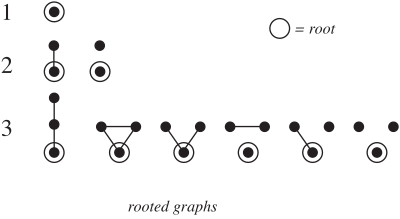
A rooted graph is a graph in which one node is labeled in a special way so as to distinguish it from other nodes. The special node is called
the root vertex of the graph.
Rooted simple graphs on  nodes correspond to symmetric
relations on
 nodes. The counting polynomial for rooted simple graphs
with
 points, counted up to root-preserving
graph isomorphism, is
 |
(1)
|
where  is the symmetric group
 acting on
 points with point
 fixed,
 is its pair group,
and
 the corresponding
cycle index (Harary 1994, p. 186). The first
few cycle indices are
 |  |  |
(2)
|
 |  |  |
(3)
|
 |  |  |
(4)
|
 |  |  |
(5)
|
 |  |  |
(6)
|
Plugging in  gives the counting polynomials
 |  |  |
(7)
|
 |  |  |
(8)
|
 |  |  |
(9)
|
 |  |  |
(10)
|
This gives the array of rooted graphs on  nodes with
 edges as illustrated in the following table (OEIS A070166).
 |  , 1, 2, ... |
| 1 | 1 |
| 2 | 1, 1 |
| 3 | 1, 2, 2, 1 |
| 4 | 1, 2, 4, 6, 4, 2, 1 |
| 5 | 1, 2, 5, 11, 17, 18, 17, 11, 5, 2, 1 |
Substituting  into
 then gives the numbers of rooted graphs on
 , 2, ... nodes as 1, 2, 6, 20, 90, 544, ... (OEIS A000666).
