


Roman numerals are a system of numerical notations used by the Romans. They are an additive (and subtractive) system in which letters are used to denote certain "base" numbers, and arbitrary numbers are then denoted using combinations of symbols. Unfortunately, little is known about the origin of the Roman numeral system (Cajori 1993, p. 30).
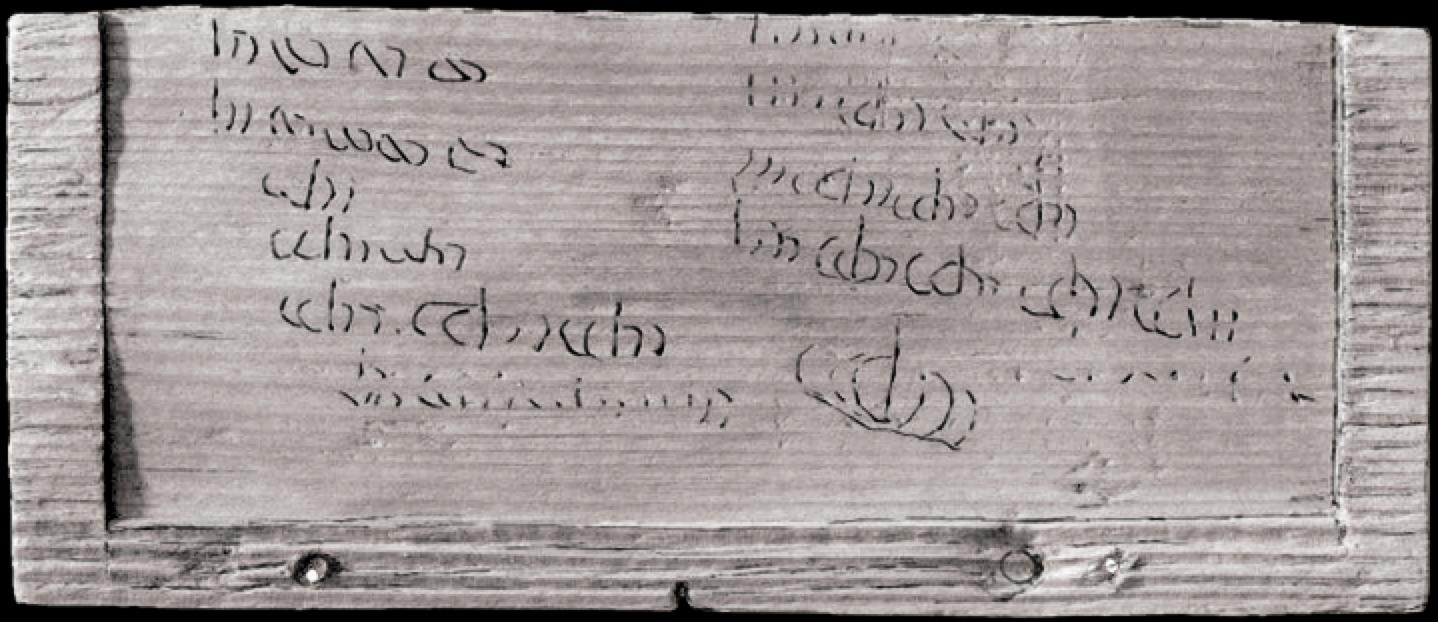
The first-century AD stylus tablet WT78, found at the Bloomberg excavations in London, preserves Roman notation for numbers as large as 100000. Its two columns of numerical symbols, interpreted as a writing exercise, provide evidence for how the Romans wrote large numbers beyond those represented by the familiar letters I through M (Tomlin 2016, pp. 237-239).
The following table gives the Latin letters used in Roman numerals and the corresponding numerical values they represent.
| character | numerical value |
| I | 1 |
| V | 5 |
| X | 10 |
| L | 50 |
| C | 100 |
| D | 500 |
| M | 1000 |
For example, the number 1732 would be denoted MDCCXXXII in Roman numerals. However, Roman numerals are not a purely additive number system. In particular, instead of using four symbols to represent a 4, 40, 9, 90, etc. (i.e., IIII, XXXX, VIIII, LXXXX, etc.), such numbers are instead denoted by preceding the symbol for 5, 50, 10, 100, etc., with a symbol indicating subtraction. For example, 4 is denoted IV, 9 as IX, 40 as XL, etc. However, this rule is generally not followed on the faces of clocks, where IIII is usually encountered instead of IV. Furthermore, the practice of placing smaller digits before large ones to indicate subtraction of value was hardly ever used by Romans and came into popularity in Europe after the invention of the printing press (Wells 1986, p. 60; Cajori 1993, p. 31).
The following table gives the (Europeanized) Roman numerals for the first few positive integers.
| # | RN | # | RN | # | RN |
| 1 | I | 11 | XI | 21 | XXI |
| 2 | II | 12 | XII | 22 | XXII |
| 3 | III | 13 | XIII | 23 | XXIII |
| 4 | IV | 14 | XIV | 24 | XXIV |
| 5 | V | 15 | XV | 25 | XXV |
| 6 | VI | 16 | XVI | 26 | XXVI |
| 7 | VII | 17 | XVII | 27 | XXVII |
| 8 | VIII | 18 | XVIII | 28 | XXVIII |
| 9 | IX | 19 | XIX | 29 | XXIX |
| 10 | X | 20 | XX | 30 | XXX |

For large numbers, the Romans placed a partial frame around numbers (open at the bottom), which indicated that the framed number was to
be multiplied by  ,
as illustrated above (Menninger 1992, p. 44; Cajori 1993, p. 32). In more
recent practice, the strokes were sometimes written only on the sides, e.g.,
,
as illustrated above (Menninger 1992, p. 44; Cajori 1993, p. 32). In more
recent practice, the strokes were sometimes written only on the sides, e.g.,  (Cajori 19993, p. 32). It should
also be noted that the Romans themselves never wrote M for 1000, but instead wrote
(I) for
(Cajori 19993, p. 32). It should
also be noted that the Romans themselves never wrote M for 1000, but instead wrote
(I) for  ,
(I)(I) for
,
(I)(I) for  ,
etc., and also occasionally wrote IM, IIM, etc. (Menninger 1992, p. 281; Cajori
1993, p. 32). However, in the Middle Ages, the use of M became quite common.
The Romans sometimes used multiple parentheses to denote nested multiplications by
10, so (I) for
,
etc., and also occasionally wrote IM, IIM, etc. (Menninger 1992, p. 281; Cajori
1993, p. 32). However, in the Middle Ages, the use of M became quite common.
The Romans sometimes used multiple parentheses to denote nested multiplications by
10, so (I) for  ,
((I)) for
,
((I)) for  ,
(((I))) for
,
(((I))) for  ,
etc. (Cajori 1993, p. 33).
,
etc. (Cajori 1993, p. 33).
The Romans also occasionally used a vinculum (called a titulus in the Middle Ages) over a Roman numeral to indicate multiplication by
1000, so  ,
,
 , etc. (Menninger 1992, p. 281;
Cajori 1993, p. 32).
, etc. (Menninger 1992, p. 281;
Cajori 1993, p. 32).
Roman numerals are encountered in the release year for movies and occasionally on the numerals on the faces of watches and clocks, but in few other modern instances. They do have the advantage that addition can be done "symbolically" (and without worrying about the "place" of a given digit) by simply combining all the symbols together, grouping, writing groups of five Is as V, groups of two Vs as X, etc.
The Roman numeral corresponding to a Hindu-Arabic number  may be obtained in the Wolfram
Language using IntegerString[n,
"Roman"].
may be obtained in the Wolfram
Language using IntegerString[n,
"Roman"].
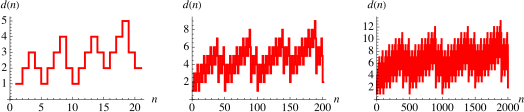
The number of characters in the Roman numerals for 1, 2, 3, 4, 5, 6, 7, 8, 9, 10, ... (i.e., I, II, III, IV, V, VI, VII, VIII, IX, X, ...) are 1, 2, 3, 2, 1, 2, 3, 4, 2, 1, 2, 3, 4, ... (OEIS A006968). This leads to a scale-invariant fractal-like stairstep pattern which rises in steps then falls abruptly.

 Villegas, R. "Antique Notations."