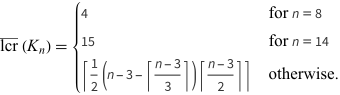
Ábrego and Fernández-Merchant (2017) determined the rectilinear local crossing number of the complete graph for every positive integer
to be
(1)
where
denotes the ceiling function. The sequence
given by the ceiling expression is 0, 0, 0, 0, 1, 1, 2, 3, 4, 6, 8, 9, 12, 14, ...
(OEIS A374243). It agrees with the rectilinear
local crossing numbers except at and , where the values are 4 and 15, respectively.
Ábrego, B. M. and Fernández-Merchant, S. "The Rectilinear Local Crossing Number of ." J. Combin. Th. Ser. A151, 131-145,
2017. https://doi.org/10.1016/j.jcta.2017.04.003.Lara,
D.; Rubio-Montiel, C.; and Zaragoza, F. "Grundy and Pseudo-Grundy Indices for
Complete Geometric Graphs." In Abstracts of the XVI Spanish Meeting on Computational
Geometry. Barcelona, Spain: July 1-3, 2015.Sloane, N. J. A.
Sequence A374243 in "The On-Line Encyclopedia
of Integer Sequences."


 ,
denoted
 ,
is the minimum, over all straight
line drawings of
 in the plane, of the largest number
of other edges crossing the interior of a single graph edge. The vertices
are required to be in general position, meaning
that no three are collinear. The value is 0 when
 has no edges.
 for every positive integer
 to be
 denotes the ceiling function. The sequence
given by the ceiling expression is 0, 0, 0, 0, 1, 1, 2, 3, 4, 6, 8, 9, 12, 14, ...
(OEIS A374243). It agrees with the rectilinear
local crossing numbers except at
 and
 , where the values are 4 and 15, respectively.

 ." J. Combin. Th. Ser. A 151, 131-145,
2017.