


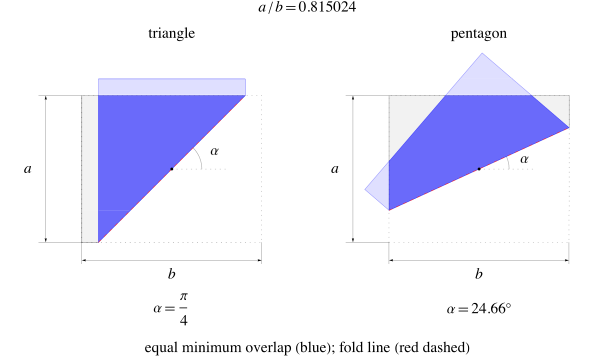
Rectangle folding is the operation of folding a rectangle along a straight line. One optimization problem asks which
fold through the center minimizes the area
covered by both halves. Let the side lengths be  . The minimizing shape changes at the aspect
ratio
 (Gaichenkov 2023, pp. 1-6). For
 , the minimum overlap is
a triangle of area
 , obtained by a fold at
 to a side. For
 , the minimum overlap
is a pentagon. At
 , both shapes attain the same minimum area,
as illustrated above. For a square, the optimal fold makes
an angle
 or
 with a side and the minimum overlap area
is
 (Gaichenkov 2023, pp. 4-6).
For  , the pentagonal minimum occurs at an
angle
 or
 to a side of length
 , where
 is the smallest positive root of
the quartic equation (Gaichenkov 2023, pp. 2-6)
 |
(1)
|
The threshold is obtained from the unique real root  (OEIS A366185)
of the quintic equation
 |
(2)
|
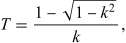
using
 |
(3)
|
where  .
If the crease crosses the interior of the rectangle but is otherwise unrestricted in position, the overlap area
has infimum 0, which is not attained. Folding an isosceles
right triangle with legs  , where
 , at a corner of the rectangle
produces overlap area
 . This approaches 0 as
 , while every crease crossing the interior
of the rectangle produces positive overlap area.
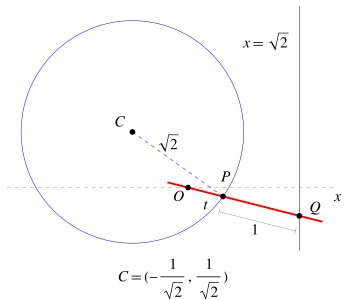
The auxiliary root  admits a neusis construction
(Gaichenkov 2026, pp. 2-3). In Cartesian
coordinates, draw the line
 and the circle with center
 and radius
 . Slide a ruler with
two marks one unit apart through the origin
 so that the nearer mark
 lies on the circle and the farther
mark
 lies on the line, with
 between the origin and
 . Choosing
 below the x-axis gives
 . The formulas above then construct the threshold
aspect ratio
 from
 .
