TOPICS
Search

Random Polynomial


A random polynomial is a polynomial having random coefficients.

Let
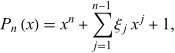
 P_n(x)=x^n+sum_(j=1)^(n-1)xi_jx^j+1,

where the xi_j are independent and uniformly distributed on {0,1}. Kogler (2026) proved the Odlyzko-Poonen conjecture that the probability that P_n is irreducible over the rational numbers tends to 1 as n->infty.

Kogler (2026) states that the proofs were generated by GPT-6 Astra, then rewritten and checked by the author. The paper also reports that Emmanuel Breuillard checked the proof and that GPT-6 Astra formalized the results and required background in Lean.

A random Littlewood polynomial instead has independently chosen coefficients in {-1,1}.

For a different model, let P_n(x)=sum_(j=0)^(n)xi_jx^j use the first n+1 terms of a single infinite sequence of independent identically distributed real random variables. Assume Exi_0=0, Exi_0^2=1, and Ee^(lambda|xi_0|)<infty for some lambda>0. If N_n counts the distinct real roots of P_n, Chen et al. (2026) proved that the set of subsequential limits of N_n/lnn is almost surely

 [1/pi,1/pi+C_*],

where C_*>1/pi is a universal constant defined by J(C_*)=1. Here J(a)=sup_(theta>=0)(atheta-psi(theta)), with psi(theta)=(4pi)^(-1)intRln(1+(e^(2theta)-1)sech(pit/2))dt, is the upper-tail rate function for the zero count of the stationary Gaussian process with covariance sech(u-v). In particular N_n/lnn does not converge almost surely. The lower limit 1/pi remains valid under the weaker condition E|xi_0|^(2+delta)<infty for some delta>0. This sample-path assertion concerns coupled successive polynomials, whereas the Kac formula concerns an expectation.


See also

Kac Formula, Littlewood Polynomial

Explore with Wolfram|Alpha

References

Bharucha-Reid, A. T. and Sambandham, M. Random Polynomials. New York: Academic Press, 1986.Bloch, A. and Pólya, G. "On the Zeros of Certain Algebraic Equations." Proc. London Math. Soc. 33, 102-114, 1932.Chen, Z.; Liu, X.; Peng, J.; Wang, H.; and Zhang, M. "The Limit Point Set of Real Roots of Random Polynomials: A Resolution of Erdős Problem 521." 12 Nov 2026. https://arxiv.org/abs/2611.16157v1.Edelman, A. and Kostlan, E. "How Many Zeros of a Random Polynomial Are Real?" Bull. Amer. Math. Soc. 32, 1-37, 1995.Erdős, P. and Turán, P. "On the Distribution of Roots of Polynomials." Ann. Math. 51, 105-119, 1950.Hammersley, J. "The Zeros of a Random Polynomial." Proc. Third Berkeley Symp. Math. Stat. Prob. 2, 89-111, 1956.Kac, M. "On the Average Number of Real Roots of a Random Algebraic Equation." Bull. Amer. Math. Soc. 49, 314-320, 1943.Kac, M. "A Correction to 'On the Average Number of Real Roots of a Random Algebraic Equation.' " Bull. Amer. Math. Soc. 49, 938, 1943.Kawada, S. "Universal Radial Laws for Random Polynomials: Erdős Problem #522 and Non-Universal Fluctuations." 8 Oct 2026. https://arxiv.org/abs/2610.11324.Kogler, C. "The Odlyzko-Poonen Conjecture on Irreducibility of Random Polynomials." 22 Sep 2026. https://arxiv.org/abs/2609.26771.Kostlan, E. "On the Distribution of Roots of Random Polynomials." Ch. 38 in From Topology to Computation: Proceedings of the Smalefest (Ed. M. W. Hirsch, J. E. Marsden, and M. Shub). New York: Springer-Verlag, pp. 419-431, 1993. https://doi.org/10.1007/978-1-4612-2740-3_38.Littlewood, J. and Offord, A. "On the Number of Real Roots of a Random Algebraic Equation." J. London Math. Soc. 13, 288-295, 1938.Maslova, N. "On the Distribution of the Number of Reals Roots of a Random Polynomial" [In Russian]. Teor. Veroyatnost. i Primenen 19, 488-500, 1974.Rice, S. O. "The Distribution of the Maxima of a Random Curve." Amer. J. Math. 61, 409-416, 1939.Rice, S. O. "Mathematical Analysis of Random Noise." Bell Syst. Tech. J. 24, 45-156, 1945.Shmerling, E. and Hochberg, K. J. "Sturm's Method in Counting Roots of Random Polynomial Equations." Methodol. Comput. Appl. Probab. 6, 203-218, 2004. https://doi.org/10.1023/B:MCAP.0000017713.58934.d3.

Referenced on Wolfram|Alpha

Random Polynomial

Cite this as:

Weisstein, Eric W. "Random Polynomial." From MathWorld--A Wolfram Resource. https://mathworld.wolfram.com/RandomPolynomial.html

Subject classifications

