

The ramification index measures multiplicity in ramified maps and field extensions. For a finite
extension  of local fields, it is the positive integer
  defined by
 |
where  and
and  are the maximal ideals in the corresponding valuation
rings.
are the maximal ideals in the corresponding valuation
rings.
For a point  with
with  ,
the ramification index of
,
the ramification index of  at
at  is a positive integer
  such that there is some open
neighborhood
such that there is some open
neighborhood  of
of  so that
 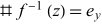 has only one preimage in
  , i.e.,
  , and for all other points
  , the cardinality
of the preimage in
, the cardinality
of the preimage in  satisfies
  .
In other words, the map from
.
In other words, the map from  to
to  is
is  to 1 except at
  . At all but finitely many points of
  ,
,  . For any point
  ,
,  . The ramification index of
  at
at  is sometimes called the valency of
  .
.
