

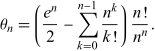
The Ramanujan sequence is the sequence  defined by
  and, for positive
integers
and, for positive
integers  ,
,
 |
(1)
|
Ramanujan (1911) introduced this correction in comparing  with the partial sum of
the power series for the exponential
function through
with the partial sum of
the power series for the exponential
function through  .
Multiplying the difference by
.
Multiplying the difference by  expresses it in units of the next term
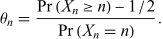
  . Equivalently, for
  , if
, if  has a Poisson distribution
with mean
has a Poisson distribution
with mean  , then
 |
(2)
|
Thus  measures the upper-tail excess over one half in units of the probability
at the mean, a connection used to study statistical
medians of Poisson distributions and
gamma distributions (Alm 2003).
measures the upper-tail excess over one half in units of the probability
at the mean, a connection used to study statistical
medians of Poisson distributions and
gamma distributions (Alm 2003).
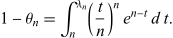
More precisely, let  denote the statistical median of a unit-scale
gamma distribution with shape
denote the statistical median of a unit-scale
gamma distribution with shape  . For
. For  , Choi (1994, p. 249) proved the exact identity
 |
(3)
|
The first few terms are
 |  |  |
(4)
|
 |  |  |
(5)
|
 |  |  |
(6)
|
 |  |  |
(7)
|
 |  |  |
(8)
|
It is a decreasing sequence with limit  and satisfies
  for
for  (Adell and Jodrá 2008, Bakan et al. 2016).
As  ,
it has the divergent asymptotic expansion
,
it has the divergent asymptotic expansion
 |
(9)
|
The coefficients can be computed directly from
![rho_r=-2^rr![z^(2r+1)]{(z^2)/(2(e^z-1-z))}^(r+1),](/images/equations/RamanujanSequence/NumberedEquation5.svg) |
(10)
|
where  is a nonnegative integer and
 ![[z^k]f(z)](/images/equations/RamanujanSequence/Inline35.svg) denotes the coefficient
of
denotes the coefficient
of  in
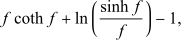
in  (O'Sullivan 2023). Integrating their exponential
generating function from 0 to
(O'Sullivan 2023). Integrating their exponential
generating function from 0 to  gives the implicit representation
 |  |  |
(11)
|
 |  |  |
(12)
|
where  is the formal power series in
  specified by the second equation and
  . The numerators
of the displayed coefficients are 1, 4,
. The numerators
of the displayed coefficients are 1, 4,  ,
,  , ... (OEIS A260306),
and their denominators are 3, 135, 2835, 8505, ...
(OEIS A065973).
, ... (OEIS A260306),
and their denominators are 3, 135, 2835, 8505, ...
(OEIS A065973).
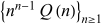
Knuth's Ramanujan  -function
is defined for positive integers
-function
is defined for positive integers 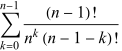 by
by
 |  |  |
(13)
|
 |  |  |
(14)
|
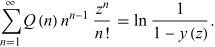
If  is the formal power series satisfying
  and
and  , the exponential
generating function of the weighted sequence
, the exponential
generating function of the weighted sequence  is
is
 |
(15)
|
The function arose in Knuth's analysis of hashing with linear probing and also occurs in the birthday problem, random mapping statistics and Pollard's rho method for prime factorization, union-find algorithms under the random spanning tree model, optimum caching, and memory-conflict problems (Knuth 1985; Flajolet et al. 1995, pp. 105-106).

 ." Ramanujan J. 16, 1-5, 2008.
  -Function."
J. Comput. Appl. Math. 58, 103-116, 1995.
-Function."
J. Comput. Appl. Math. 58, 103-116, 1995.