TOPICS
Search

Rabbit Sequence


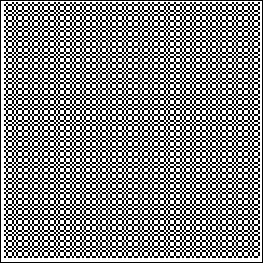
Rabbit sequence recurrence plot

The rabbit sequence is the infinite sequence of binary digits obtained by iterating the substitution system 0->1, 1->10, starting with 0. It arises in a hypothetical model of rabbit reproduction, where 0->1 corresponds to young rabbits growing old and 1->10 corresponds to old rabbits producing young rabbits. The successive iterations using string rewriting are 1, 10, 101, 10110, 10110101, 1011010110110, .... Each of these strings is an initial segment of the next. A recurrence plot of the infinite sequence is illustrated above.

Interpreted as binary integers and converted to decimal, the successive iterations give 1, 2, 5, 22, 181, ... (OEIS A005203, starting at index 1), with the value after n iterations given by the recurrence relation

 a(n)=a(n-1)2^(F_(n-1))+a(n-2)

for integers n>=2, where a(0)=0, a(1)=1, and F_n is the nth Fibonacci number with F_0=0 and F_1=1.

The real number with binary expansion 0.1011010110110..._2 whose binary digits form the infinite sequence (OEIS A005614) is called the rabbit constant.



See also

Fibonacci Number, Rabbit Constant, Thue-Morse Sequence

Explore with Wolfram|Alpha

References

Davison, J. L. "A Series and Its Associated Continued Fraction." Proc. Amer. Math. Soc. 63, 29-32, 1977. https://doi.org/10.1090/S0002-9939-1977-0429778-5.Gould, H. W.; Kim, J. B.; and Hoggatt, V. E. Jr. "Sequences Associated with t-ary Coding of Fibonacci's Rabbits." Fib. Quart. 15, 311-318, 1977. https://www.fq.math.ca/Scanned/15-4/gould.pdf.Schroeder, M. Fractals, Chaos, Power Laws: Minutes from an Infinite Paradise. New York: W. H. Freeman, p. 55, 1991.Sloane, N. J. A. Sequences A005203/M1539 and A005614 in "The On-Line Encyclopedia of Integer Sequences."

Referenced on Wolfram|Alpha

Rabbit Sequence

Cite this as:

Weisstein, Eric W. "Rabbit Sequence." From MathWorld--A Wolfram Resource. https://mathworld.wolfram.com/RabbitSequence.html

Subject classifications