


The quantitative Monsky problem asks how nearly an odd number of triangles in a dissection of a unit
square can have equal areas. For a dissection  into
into  nondegenerate triangles with areas
  ,
define
,
define
 |
(1)
|
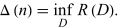
and let
 |
(2)
|
The infimum is attained for every  . Monsky's theorem (Monsky 1970) implies that
  for every fixed odd
  .
.
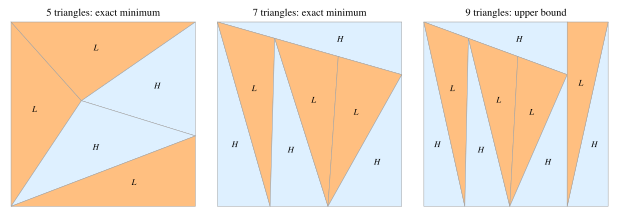
The dissections illustrated above contain five, seven, and nine triangles. The labels  and
and  indicate the larger and smaller areas,
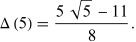
respectively. Li (2026) proved the exact value
indicate the larger and smaller areas,
respectively. Li (2026) proved the exact value
 |
(3)
|
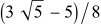
Every minimizing dissection into five triangles has three triangles of area  and two triangles of area
  .
For seven triangles,
.
For seven triangles,
 |
(4)
|
where  is the unique root in
  of
of
 |
(5)
|
Every minimizing dissection into seven triangles has four triangles of area  and three triangles of area
  .
.
Li (2026) also constructed a dissection into nine triangles proving
 |
(6)
|
where  is the unique root in
  of
of
 |
(7)
|
This construction has five triangles of area  and four triangles of area
  .
The value
.
The value  is the exact minimum within the tilted-strip construction, but the exact value of
 remains open.
Li (2026) reports that OpenAI GPT models accessed through ChatGPT and Codex contributed substantially to refining the research program, exploring constructions, developing proof decompositions, and designing and auditing the verification code. The author selected and checked the final statements, arguments, and code and assumes responsibility for the results.
