


A Pythagorean quadruple is a set of positive integers  ,
 ,
 , and
 that satisfy
 |
(1)
|
For positive even  and
 , there exist such integers
 and
 ; for positive odd
 and
 , no such integers exist (Oliverio
1996).
Examples of primitive Pythagorean quadruples include  ,
 ,
 ,
 ,
 , and
 .
A Pythagorean quadruple  determines a Heronian
triangle with side lengths
 ,
 , and
 , semiperimeter
 , and area
 (F. M. Jackson, pers. comm.,
Dec. 3, 2023).
The family
 |
(2)
|
for positive integers  produces Soddyian triangles
under this construction (F. M. Jackson, pers. comm., Oct. 17, 2026).
For example,
 and
 give
 and the Soddyian triangle with side lengths
(13, 40, 45).
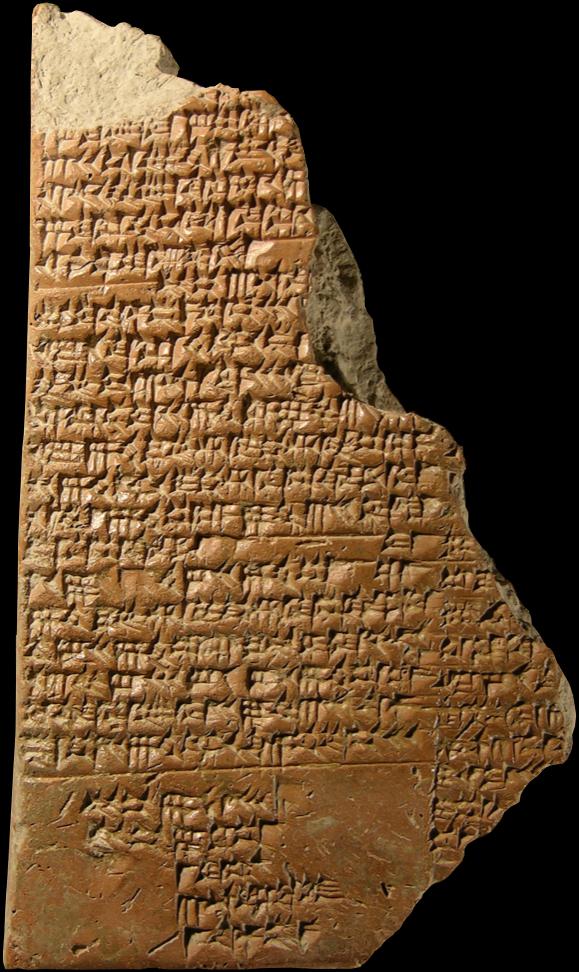
An Old Babylonian tablet dated to roughly 1900-1600 BC computes the space diagonal of a rectangular gate whose scaled thickness, width,
height, and diagonal form
the Pythagorean quadruple  . Thus it records an exact three-dimensional use
of the Pythagorean theorem long before the
surviving Greek treatments (Friberg 2007).
Oliverio (1996) gives the following generalization of this result. Let  , where
 are integers, and let
 be the number of odd integers
in
 .
Then iff
 (mod 4), there exist integers
 and
 such that
 |
(3)
|
A set of Pythagorean quadruples is given by
 |  |  |
(4)
|
 |  |  |
(5)
|
 |  |  |
(6)
|
 |  |  |
(7)
|
where  ,
 ,
and
 are integers (Mordell 1969). This does not, however,
generate all solutions. For instance, it excludes (36, 8, 3, 37).

 -tuples." Fib. Quart. 34, 98-101, 1996.