

Pythagorean addition combines two real numbers  and
 to give
 , the Euclidean
norm of
 . The operation is used when computing vector norms,
the Frobenius norm, and Givens
rotations.
Directly squaring the inputs in floating-point arithmetic can cause overflow or underflow even when the final norm is representable. For finite inputs, set  and
 . If
 , the result is zero. Otherwise, evaluate
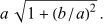 |
Since  , the intermediate square cannot overflow. Moler
and Morrison (1983) and Dubrulle (1983) describe iterative alternatives.

 ."
ACM Trans. Math. Softw. 47, Art. 9, 2021.