


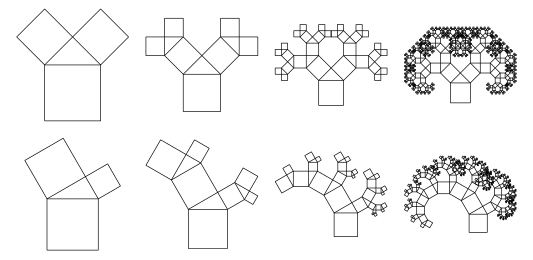
The Pythagoras tree is a fractal constructed iteratively from a right triangle with squares erected on each of the sides. Subsequent iterations add additional similar right triangles with erected squares on the outward-facing edges of the squares from the previous iteration. Using an isosceles right triangle gives an attractive symmetric form resembling a tree, while using a general right triangle gives a bent tree somewhat reminiscent of a willow tree. Examples of both forms are illustrated above.
If a parent square has side length  , the two child squares may
be parameterized by
 |  |  |
(1)
|
 |  |  |
(2)
|
where  . The Pythagorean
theorem gives
 , so the child areas sum to the parent area (Trott
2004, pp. 14-15). The choice
 gives the symmetric tree. At every level, the sum of the
areas of the squares, counted
with multiplicity, equals the initial area. Overlapping
squares mean that this is not generally the area
of their union.
