

A proper factor of a positive integer  is a factor of
  other than 1 or
  (Derbyshire 2004, p. 32). For example, 2 and 3 are positive
proper factors of 6, but 1 and 6 are not.
(Derbyshire 2004, p. 32). For example, 2 and 3 are positive
proper factors of 6, but 1 and 6 are not.
Compare with the term proper divisor, which means a factor of  other than
  (but including 1).
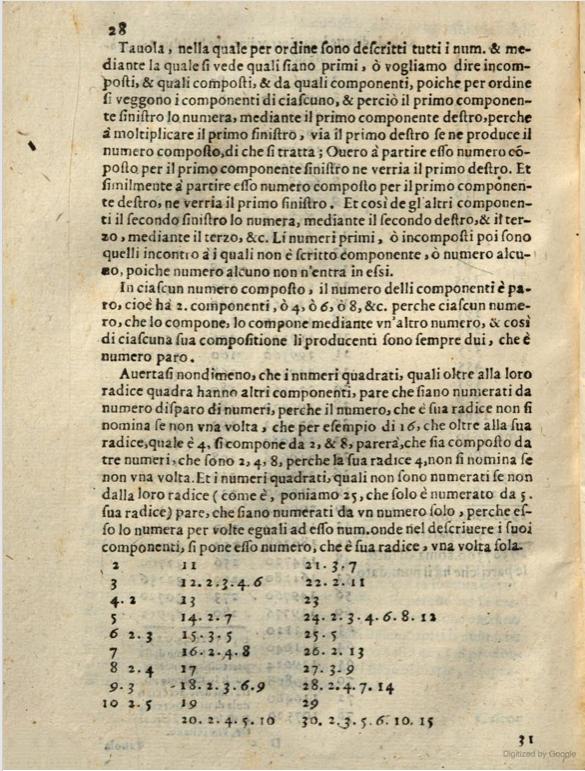
Cataldi's table, one of the oldest published divisor tables, listed the positive proper factors of integers up to 750. It was used in his investigation of Mersenne primes (History of Mathematics Project n.d.). The entries from 2 through 30 on the page reproduced above are transcribed below. Blank lists identify primes.
 | proper factors |  | proper factors |  | proper factors |
| 2 | 11 | 21 |  | ||
| 3 | 12 |  | 22 |  | |
| 4 | 2 | 13 | 23 | ||
| 5 | 14 |  | 24 |  | |
| 6 |  | 15 |  | 25 | 5 |
| 7 | 16 |  | 26 |  | |
| 8 |  | 17 | 27 |  | |
| 9 | 3 | 18 |  | 28 |  |
| 10 |  | 19 | 29 | ||
| 20 |  | 30 |  |
