

A primitive element of a finite extension  is an element
 such that
 . If
 , then 1,
 , ...,
 form a vector basis
of
 over
 ,
and every element of
 is a polynomial in
 of polynomial degree
less than
 with coefficients in
 . The extension field
degree
 is the polynomial degree of the extension
field minimal polynomial of
 over
 .
The primitive element theorem states that every finite extension that is a separable extension
has a primitive element (Milne 2022, pp. 61-62). In particular, for any algebraic
numbers  ,
...,
 ,
there is a single algebraic number
 such that
 . Each
 can therefore be expressed as a polynomial
in
 with rational coefficients.
For example, a primitive element of 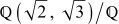 is given by
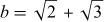 , with
 |  |  |
(1)
|
 |  |  |
(2)
|
Primitive elements were implemented in versions of the Wolfram Language prior to 6 as PrimitiveElement[z,  a1, ..., an
 ] (after loading the package NumberTheory`PrimitiveElement`).
In finite field terminology, a primitive element often means a generator of the multiplicative group of nonzero elements (Lidl and Niederreiter 1997). This is stronger than generating the extension field as a field. The Morgan-Mullen conjecture asks for a multiplicative generator that is also a completely normal element.
