

Polynomial norms measure the size of a polynomial. For a polynomial
 |
(1)
|
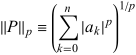
several classes of norms are commonly defined. The  -norm is defined as
 |
(2)
|
for  ,
giving the special cases
,
giving the special cases
 |  |  |
(3)
|
 |  |  |
(4)
|
 |  |  |
(5)
|
Here,  is called the polynomial height. Note that some
authors (especially in the area of Diophantine analysis) use
is called the polynomial height. Note that some
authors (especially in the area of Diophantine analysis) use  as a shorthand for
  and
and  as a shorthand for
  , while others (especially in the area of computational
complexity) use
, while others (especially in the area of computational
complexity) use  to denote the
  -norm
-norm
 (Zippel 1993, p. 174).
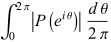
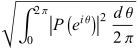
Another class of norms is the  -norms, defined by
![||P||_(L_p)=[int_0^(2pi)|P(e^(itheta))|^p(dtheta)/(2pi)]^(1/p)](/images/equations/PolynomialNorm/NumberedEquation3.svg) |
(6)
|
for  ,
giving the special cases
,
giving the special cases
 |  |  |
(7)
|
 |  |  |
(8)
|
 |  |  |
(9)
|
(Borwein and Erdélyi 1995, p. 6).
The integral formula extends to a quasi-norm for  , and its limiting value as
 is the Mahler
measure. Zhang (2026) proved that, for a polynomial
is the Mahler
measure. Zhang (2026) proved that, for a polynomial  of polynomial
degree
of polynomial
degree  with all its roots on the unit
circle, the ratio
with all its roots on the unit
circle, the ratio  is nondecreasing for
  ,
with these endpoint conventions. This is the Baernstein
quasi-norm monotonicity conjecture.
,
with these endpoint conventions. This is the Baernstein
quasi-norm monotonicity conjecture.

 ." §1.1.E.3 in