


A polygonal radix representation is a positional representation of a complex number using a base  and a digit alphabet
consisting of zero and the vertices of a regular polygon
on the unit circle (Safer 1999). For an
 -sided regular polygon,
take
 and
 |
(1)
|
For  ,
a representation has the form
 |
(2)
|
where  is an integer and every
 . It is finite if only finitely many digits
are nonzero. The condition
 ensures convergence
of the fractional tail, but does not by itself ensure that every complex
number has such a representation. Completeness depends on both the base
and the digit alphabet (Safer
1999).
The set of fractional representations satisfies
 |  | 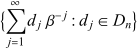 |
(3)
|
 |  |  |
(4)
|
It is therefore the attractor of the iterated function system with maps  .

For the square digit alphabet  and base
 , the illustration shows the digits
and six-digit fractional sums. Colors distinguish the first
digit, corresponding to the five images
 of the attractor.
