TOPICS
Search

Poloidal Field


A poloidal field relative to a chosen origin is a vector field of the form

 P=del x[del x(Sr)],

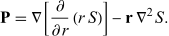
where r is the position vector from that origin and S is a sufficiently smooth scalar function (Backus 1986). For r=|r|>0, the equivalent expression is

 P=del [partial/(partialr)(rS)]-rdel ^2S.

Here del is the gradient, del x is the curl, and del ^2 is the Laplacian. A poloidal field is a divergenceless field, also called a solenoidal field, because the divergence of a curl vanishes.

A sufficiently smooth divergenceless field on a spherical shell centered at the chosen origin, with zero flux integral through each concentric sphere, can be decomposed into a poloidal field and a toroidal field (Backus 1986). In general, these components change when the chosen origin changes. This separation is important in geo- and heliophysics, and in particular in dynamo theory and helioseismology.


See also

Divergenceless Field, Toroidal Field, Vector Field

Explore with Wolfram|Alpha

References

Backus, G. "Poloidal and Toroidal Fields in Geomagnetic Field Modeling." Rev. Geophys. 24, 75-109, 1986. https://doi.org/10.1029/RG024i001p00075.Krause, F. and Raedler, K.-H. Mean-Field Magnetohydrodynamics and Dynamo Theory. Berlin, Germany: Akademie-Verlag, pp. 163 and 167, 1980.Roberts, P. H. An Introduction to Magnetohydrodynamics. New York: American Elsevier, p. 81, 1967.Stacey, F. D. Physics of the Earth, 2nd ed. New York: Wiley, p. 239, 1977.

Cite this as:

Weisstein, Eric W. "Poloidal Field." From MathWorld--A Wolfram Resource. https://mathworld.wolfram.com/PoloidalField.html

Subject classifications