

The term "polar vector" has two different definitions.
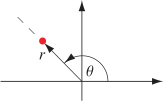
In elementary math, the term "polar vector" is used to refer to a representation of a vector as a vector magnitude (length) and angle, which is equivalent to specifying its endpoints in polar coordinates (illustrated above).
In physics, a polar vector transforms as an ordinary vector under an orthogonal transformation,
without the extra determinant factor that characterizes
a pseudovector. When a physical configuration is
inverted relative to a fixed right-handed
coordinate system, a polar vector reverses direction whereas a pseudovector
does not. This is distinct from a passive change of coordinate axes. Examples of
polar vectors include the radius vector  , the velocity vector
  , momentum
  , and force
  . The cross product of two
polar vectors is a pseudovector.
. The cross product of two
polar vectors is a pseudovector.
