See also
Binomial Distribution,
Le Cam's Inequality,
Poisson
Distribution
Explore with Wolfram|Alpha
References
Barbour, A. D.; Holst, L.; and Janson, S. Poisson Approximation. Oxford, England: Clarendon Press, 1992.Feller,
W. "The Poisson Approximation." §6.5 in An
Introduction to Probability Theory and Its Applications, Vol. 1, 3rd ed.
New York: Wiley, pp. 153-155, 1968.Le Cam, L. "An Approximation
Theorem for the Poisson Binomial Distribution." Pacific J. Math. 10,
1181-1197, 1960.Papoulis, A. Probability,
Random Variables, and Stochastic Processes, 2nd ed. New York: McGraw-Hill,
p. 71, 1984.Referenced on Wolfram|Alpha
Poisson Theorem
Cite this as:
Weisstein, Eric W. "Poisson Theorem."
From MathWorld--A Wolfram Resource. https://mathworld.wolfram.com/PoissonTheorem.html
Subject classifications


 ,
,  , and
, and  , where
  is fixed, then
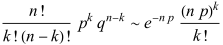
 . Thus, for large
  and small
  , the probability that an event occurs
  times in
  independent trials is approximated by

 .
This is the Poisson distribution approximation
to the binomial distribution, with mean
.
This is the Poisson distribution approximation
to the binomial distribution, with mean
 .
.
