TOPICS
Search

Poisson Binomial Distribution


The Poisson binomial distribution is the statistical distribution of a sum

 X=sum_(i=1)^nX_i,
(1)

of independent random variables X_i having Bernoulli distributions with possibly different success probabilities P(X_i=1)=p_i. Its probability generating function is

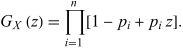
 G_X(z)=product_(i=1)^n[1-p_i+p_iz].
(2)

Consequently, P(X=k) is the coefficient of z^k in this product, while the expectation value and variance are sum_(i)p_i and sum_(i)p_i(1-p_i), respectively. If every p_i is equal, the distribution reduces to the binomial distribution. When the probabilities p_i are small, a Poisson distribution with mean sum_(i)p_i can provide an approximation.

For integers k>=0 and r>=1, let T_(k,r) be the infimum of means of finite sums S of independent random variables having Bernoulli distributions for which P(S=k+r)>P(S=k). Kleiner (2026) proved that T_(k,1)=k+1/(k+2) and T_(k,r)=k+1 for r>=3. For distance two, T_(k,2)=k+Delta_k, where

 Delta_k=(d_ksqrt((k+1)(k+2))-ksqrt(d_k(d_k-1)))/(sqrt((k+1)(k+2))+sqrt(d_k(d_k-1))),
(3)

and d_k=max{2,|_(9+sqrt(8k+33))/8_|}, with |_x_| the floor function. In particular, Delta_k=1/2+1/sqrt(2k)-1/(4k)+O(k^(-3/2)) as k->infty, where O is big-O notation.


See also

Bernoulli Distribution, Binomial Distribution, Poisson Distribution

Explore with Wolfram|Alpha

References

Johnson, N. L.; Kemp, A. W.; and Kotz, S. Univariate Discrete Distributions, 3rd ed. Hoboken, NJ: Wiley, 2005.Kleiner, I. "Why Distance Two Is Exceptional for Poisson-Binomial Point Probabilities." 7 Oct 2026. https://arxiv.org/abs/2610.10664.

Cite this as:

Weisstein, Eric W. "Poisson Binomial Distribution." From MathWorld--A Wolfram Resource. https://mathworld.wolfram.com/PoissonBinomialDistribution.html

Subject classifications




