The problem in calculus of variations to find the minimal surface of a boundary with specified
constraints (usually having no singularities on the surface). In general, there may
be one, multiple, or no minimal surfaces spanning
a given closed curve in space. The existence of a solution
to the general case was independently proven by Douglas (1931) and Radó (1933),
although their analysis could not exclude the possibility of singularities. Osserman
(1970) and Gulliver (1973) showed that a minimizing solution cannot have singularities.
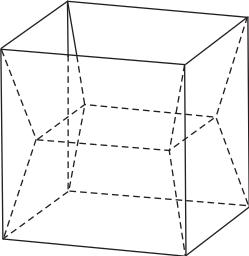
The problem is named for the Belgian physicist who solved some special cases experimentally using soap films and wire frames (Isenberg 1992, Wells 1991). The illustration above shows the 13-polygon surface obtained for a cubical wire frame.