


There are several different results informally known as the pizza theorem.
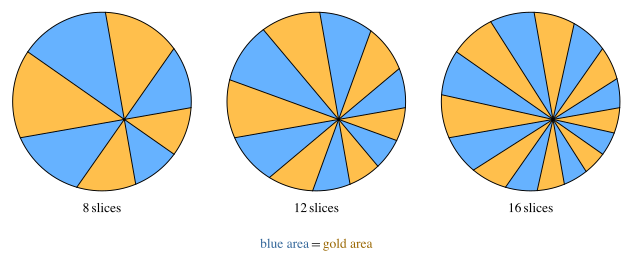
The first pizza theorem states that if a circular pizza is divided into 8, 12, 16, ... slices by making cuts at equal angles from an arbitrary interior point, then the sums of the areas of alternate slices are equal (Carter and Wagon 1994, Mabry and Deiermann 2009).
For a short proof, place the pizza's center at the origin and the cutting point
at  , where
 and
 is the pizza's radius. Let
 be the distance
from the cutting point to the circumference
along a ray at angle
 . Opposite rays satisfy
 |
(1)
|
For  slices with integer
 , each alternating group consists of
 opposite pairs spaced by
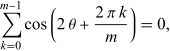
 . Since
 |
(2)
|
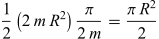
their cosine terms cancel. The area formula in polar coordinates,
applied over one slice angle  , gives
 |
(3)
|
for either group (Mabry and Deiermann 2009, Friedelmeyer 2021).
The related circle division by lines problem asks for the maximum number of regions obtainable with a given number of straight cuts.
A second pizza theorem expresses the cylinder volume formula  for a pizza of thickness
 and radius
 in the self-describing form
 |
(4)
|
(Friedelmeyer 2021).
