

A perspective projection with center  and image plane
  not containing
  maps a point
  in three-dimensional Euclidean
space to the intersection of the line
in three-dimensional Euclidean
space to the intersection of the line  with
with  . If
. If  is parallel to
  , its image is a point at
infinity. All points on the same line
through
, its image is a point at
infinity. All points on the same line
through  have the same image, so distance from
  along the line is lost.
Choose a coordinate system with  and image plane
  . A point
  with
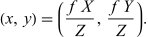
with  is mapped to the image point
  ,
where
,
where
 |
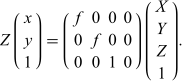
In homogeneous coordinates, the same projection is represented by
 |
These formulas give the idealized geometry of imaging from a single viewpoint (Hartley and Zisserman 2004, Torralba et al. 2024).
A perspective projection maps lines not passing through  to lines. Images of parallel lines generally meet at a vanishing
point. Consequently, perspective projection does not preserve lengths,
angles, or parallelism, unlike
an affine transformation (Torralba et
al. 2024).
to lines. Images of parallel lines generally meet at a vanishing
point. Consequently, perspective projection does not preserve lengths,
angles, or parallelism, unlike
an affine transformation (Torralba et
al. 2024).
