

A permutation test is a hypothesis testing procedure in which the observed test statistic is compared with its distribution
under transformations of the data that leave the null hypothesis invariant. Let  be a finite set of allowed permutations,
let
be a finite set of allowed permutations,
let  denote the observed data, and let
  be a statistic for which larger values are more extreme. If
the null hypothesis makes the transformed datasets
be a statistic for which larger values are more extreme. If
the null hypothesis makes the transformed datasets  equally likely, the exact one-sided
  -value is
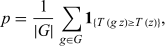 |
where  is the indicator function of an event
  . A two-sided test instead uses a prespecified
two-sided measure of extremeness.
. A two-sided test instead uses a prespecified
two-sided measure of extremeness.
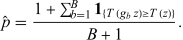
When enumerating all allowed permutations is impractical,  transformations
  , ...,
  can be sampled. A standard Monte Carlo estimate that avoids
reporting a zero
can be sampled. A standard Monte Carlo estimate that avoids
reporting a zero  -value
is
-value
is
 |
The test is valid when its null hypothesis makes the transformed datasets equally likely and the transformations respect the experimental design. Arbitrarily shuffling observations for which this condition fails does not give an exact test.

 -Values Should Never Be Zero: Calculating
Exact
-Values Should Never Be Zero: Calculating
Exact  -Values
When Permutations Are Randomly Drawn." Statist. Appl. Genet. Mol. Biol. 9,
Article 39, 2010.
-Values
When Permutations Are Randomly Drawn." Statist. Appl. Genet. Mol. Biol. 9,
Article 39, 2010.