

A Paterson prime is a prime number whose quaternary (base 4) digits, read as a decimal integer, also give a
prime number (OEIS A065722;
Numberphile 2022). Writing 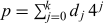 , with
 and
 , define
 |
Applied to all nonnegative integers, the digit reinterpretation gives OEIS A007090,
indexed from 0. The Paterson condition is that both  and
 are prime. The first values
are 2, 3, 5, 7, 11, 13, 17, 19, 23, 29, 37, 43, 47, 53, 61, ... (OEIS A065722).
The first ten prime numbers satisfy the condition, but the property is not universal:  gives
 , a composite
number. For comparison,
 gives the prime number
 .
Since  ,
the formula gives
 .
Consequently, for a prime number
 ,
 has neither 2 nor 3 as a divisor.
This does not exclude larger prime factors.
