

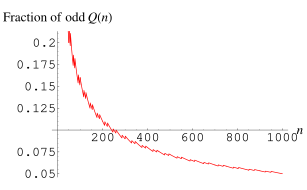
Congruences for the partition function Q include the following parity characterization. For  , 2, ..., the odd values of
 are 1, 1, 3, 5, 15, 27, 89, 165, 585, ... (OEIS A051044).
The indices of these values have asymptotic density
zero, whereas the corresponding asymptotic density
for odd values of the partition
function P is conjectured to be
 (Judge et al. 2018). The pentagonal
number theorem gives the following coefficientwise congruences
for the generating function
 , with
 :
 |  |  |
(1)
|
 |  |  |
(2)
|
 |  |  |
(3)
|
(Gordon and Ono 1997), so for  ,
 is odd iff
 is of the form
 for a positive integer
 ,
i.e., 1, 5, 12, 22, 35, ... or 2, 7, 15, 26, 40, ....
The values of  for which
 is prime are 3, 4, 5, 7,
22, 70, 100, 495, 1247, 2072, 320397, ... (OEIS A035359),
with no others for
 (Weisstein, May 6, 2000). These values correspond
to 2, 2, 3, 5, 89, 29927, 444793, 602644050950309, ... (OEIS A051005).
It is not known if
 is infinitely often prime,
but Gordon and Ono (1997) proved that it is "almost always" divisible
by any given power of 2.
For nonnegative integers  ,
 , and
 , Gordon and Hughes (1981) showed that
 |
(4)
|
and
 |
(5)
|
where  is an integer depending only on
 .

 ."
In