The only critical point in town test states that a univariate real function with a single critical point
that is a local maximum attains its global
maximum there (Wagon 1991, p. 87). The test breaks down for bivariate functions,
but does hold for bivariate polynomials of degree . Such exceptions include
Aduén, H. "The Local-to-Global Minimum Problem of Calvert and Vamanamurthy: A Quartic Counterexample in Three Variables and the
Cubic Case in All Dimensions." 1 Nov 2026. https://arxiv.org/abs/2611.02068v1.Anton,
H. Calculus:
A New Horizon, 6th ed. New York: Wiley, 1999.Apostol, T. M.;
Mugler, D. H.; Scott, D. R.; Sterrett, A. Jr.; and Watkins, A. E.
A
Century of Calculus, Part II: 1969-1991. Washington, DC: Math. Assoc. Amer.,
1992.Ash, A. M. and Sexton, H. "A Surface with One Local Minimum."
Math. Mag.58, 147-149, 1985.Calvert, B. and Vamanamurthy,
M. K. "Local and Global Extrema for Functions of Several Variables."
J. Austral. Math. Soc.29, 362-368, 1980.Davies, R. "Solution
to Problem 1235." Math. Mag.61, 59, 1988.Rosenholtz,
I. and Smylie, L. "The Only Critical Point in Town Test." Math. Mag.58,
149-150, 1985.Wagon, S. "Failure of the Only-Critical-Point-in-Town
Test." §3.4 in Mathematica
in Action. New York: W. H. Freeman, pp. 87-91 and 228, 1991.


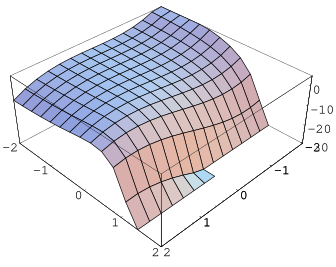
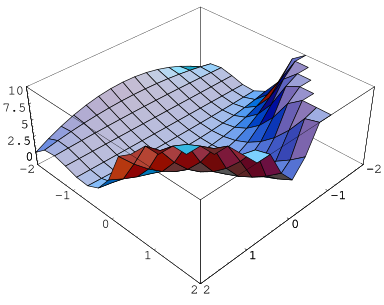
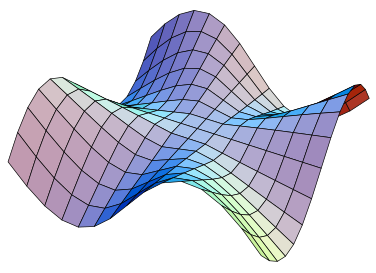
 with a single critical point
that is a local maximum attains its global
maximum there (Wagon 1991, p. 87). The test breaks down for bivariate functions,
but does hold for bivariate polynomials of degree
 . Such exceptions include


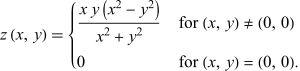
 and
 . Direct differentiation gives the unequal mixed partial
derivatives
 and
 . Both mixed partial
derivatives are discontinuous at the origin.

 is a positive
definite quadratic form, but

 ,
so this local minimum is not global. To check uniqueness,
put
 .
The equations for the gradient are






 would imply
 and
 , a contradiction. Otherwise
 implies
 , after which
 gives
 and
 gives
 .
