


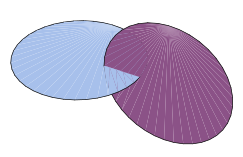
An oloid is the convex hull of two circles of equal radius  in perpendicular planes,
with the center of each circle lying on the other (Schatz
1975, p. 122; Bäsel 2018). Its boundary is
an octic surface (Trott 2004, pp. 1194-1196).
The oloid can roll smoothly on a plane.
in perpendicular planes,
with the center of each circle lying on the other (Schatz
1975, p. 122; Bäsel 2018). Its boundary is
an octic surface (Trott 2004, pp. 1194-1196).
The oloid can roll smoothly on a plane.
|
|
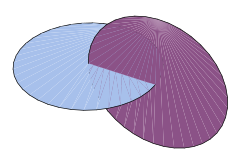
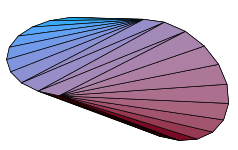
The oloid is illustrated above. For comparison, a two-circle roller is formed from two equal disks in perpendicular planes whose centers are separated by  times their radius. It also
rolls smoothly (Nishihara).
times their radius. It also
rolls smoothly (Nishihara).
For generating circles of radius  , the surface
area is
, the surface
area is
 |
(1)
|
the same as that of a sphere of radius  . The enclosed volume
has the closed form
. The enclosed volume
has the closed form
 |  | ![(2a^3)/3[K((sqrt(3))/2)+2E((sqrt(3))/2)]](/images/equations/Oloid/Inline7.svg) |
(2)
|
 |  |  |
(3)
|
where  and
and  are the complete elliptic
integral of the first kind and elliptic
integral of the second kind, respectively, with elliptic
modulus
are the complete elliptic
integral of the first kind and elliptic
integral of the second kind, respectively, with elliptic
modulus  (Bäsel 2018).
Bäsel (2018) gives the mean tangent diameter (mean width) as
 |  | ![a[3/(2pi)K((sqrt(3))/2)+(3pi)/4-(2I)/pi]](/images/equations/Oloid/Inline16.svg) |
(4)
|
 |  |  |
(5)
|
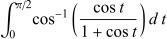
where  is defined by
 |  |  |
(6)
|
 |  |  |
(7)
|
Define the nome
 |  | ![exp[-pi(K(1/2))/(K((sqrt(3))/2))]](/images/equations/Oloid/Inline29.svg) |
(8)
|
 |  |  |
(9)
|
Then
![I=(3pi^2)/8-4piIm[lnGamma_e(iq;-q,-q)],](/images/equations/Oloid/NumberedEquation2.svg) |
(10)
|
where  is the elliptic
gamma function,
is the elliptic
gamma function,  denotes the imaginary part, and
  is the principal branch
of the natural logarithm. The equivalent rapidly
converging series is
is the principal branch
of the natural logarithm. The equivalent rapidly
converging series is
 |
(11)
|
(E. Weisstein, Sep. 23, 2026).

