


The natural logarithm of 2 continued fraction is the continued fraction expansion representing  , beginning [0; 1, 2, 3, 1, 6, 3, 1, 1, 2, 1, 1, 1, 1, 3,
10, ...] (OEIS A016730). It has been computed
to
 terms by E. Weisstein (Aug. 21, 2013).
The Engel expansion is 2, 3, 7, 9, 104, 510, 1413, ... (OEIS A059180).
Including the initial zero, the incrementally largest terms in the continued fraction are 0, 1, 2, 3, 6, 10, 13, 14, ... (OEIS A120754), which occur at positions 0, 1, 2, 3, 5, 15, 28, ... (OEIS A120755). Both displayed lists prepend 0 to the cited OEIS sequences, which exclude the initial partial quotient.

The plot above shows the positions of the first occurrences of 1, 2, 3, ... in the continued fraction, the first few of which
are 1, 2, 3, 30, 40, 5, 29, 89, 88, 15, ... (OEIS A228269).
The smallest positive integers not occurring
in the first  terms of the continued
fraction are 42112, 42387, 43072, 45089, ... (E. Weisstein, Aug. 21,
2013).

Let the continued fraction of  be denoted
 and let the denominators
of the convergents be denoted
 ,
 , ...,
 . Then plots above show successive values of
 ,
 ,
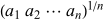 , which appear to converge to Khinchin's
constant (left figure) and
 , which appear to converge to the Lévy
constant (right figure), although neither of these limits
has been rigorously established.
