

Multiply all the digits of a number  by each other, repeating with the product until a single digit is obtained. The number of steps required is known as
the multiplicative persistence, and the final digit obtained
is called the multiplicative digital root
of
by each other, repeating with the product until a single digit is obtained. The number of steps required is known as
the multiplicative persistence, and the final digit obtained
is called the multiplicative digital root
of  .
.
For example, the sequence obtained from the starting number 9876 is (9876, 3024, 0), so 9876 has an multiplicative persistence of two and a multiplicative
digital root of 0. The multiplicative persistences of the first few positive
integers are 0, 0, 0, 0, 0, 0, 0, 0, 0, 1, 1, 1, 1, 1, 1, 1, 1, 1, 1, 1, 1, 1, 1,
1, 2, 2, 2, 2, 2, 1, 1, 1, 1, 2, 2, 2, 2, 2, 3, 1, 1, ... (OEIS A031346).
The smallest numbers having multiplicative persistences of 1, 2, ... are 10, 25,
39, 77, 679, 6788, 68889, 2677889, 26888999, 3778888999, 277777788888899, ... (OEIS
A003001; Wells 1986, p. 78). There is
no number  with multiplicative persistence
  (Carmody 2001; updating Wells 1986, p. 78). It is
conjectured that the maximum number lacking the digit 1
with persistence 11 is
(Carmody 2001; updating Wells 1986, p. 78). It is
conjectured that the maximum number lacking the digit 1
with persistence 11 is
 |
There is a stronger conjecture that there is a maximum number lacking the digit 1 for each persistence  .
.
The maximum multiplicative persistence in base 2 is 1. It is conjectured that all powers of 2  contain a 0 in base 3, which would imply that the maximum persistence in base 3 is
3 (Guy 1994).
contain a 0 in base 3, which would imply that the maximum persistence in base 3 is
3 (Guy 1994).
The multiplicative persistence of an  -digit number is also called its
number length. The maximum lengths for
-digit number is also called its
number length. The maximum lengths for  -, 2-, 3-, ..., digit numbers are 0, 4, 5, 6, 7, 7, 8, 9,
9, 10, 10, 10, ... (OEIS A014553; Beeler 1972;
Gottlieb 1969, 1970). The numbers of
-, 2-, 3-, ..., digit numbers are 0, 4, 5, 6, 7, 7, 8, 9,
9, 10, 10, 10, ... (OEIS A014553; Beeler 1972;
Gottlieb 1969, 1970). The numbers of  -digit numbers having maximal multiplicative persistence for
 ,
2, ..., are 10 (which includes the number 0), 1, 9, 12, 20, 2430, ... (OEIS A046148).
The smallest
,
2, ..., are 10 (which includes the number 0), 1, 9, 12, 20, 2430, ... (OEIS A046148).
The smallest  -digit numbers with maximal multiplicative persistence are
0, 77, 679, 6788, 68889, 168889, ... (OEIS A046149).
The largest
-digit numbers with maximal multiplicative persistence are
0, 77, 679, 6788, 68889, 168889, ... (OEIS A046149).
The largest  -digit
numbers with maximal multiplicative persistence are 9, 77, 976, 8876, 98886, 997762,
... (OEIS A046150). The number of distinct
-digit
numbers with maximal multiplicative persistence are 9, 77, 976, 8876, 98886, 997762,
... (OEIS A046150). The number of distinct
 -digit
numbers (except for 0s) are given by
-digit
numbers (except for 0s) are given by 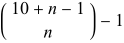 which, for
  , 2, 3, ..., gives 54, 219, 714, 2001, 5004, 11439, ... (OEIS
A035927).
, 2, 3, ..., gives 54, 219, 714, 2001, 5004, 11439, ... (OEIS
A035927).
The concept of multiplicative persistence can be generalized to multiplying the  th
powers of the digits of a number and iterating until the result remains constant.
All numbers other than repunits, which converge to 1,
converge to 0. The number of iterations required for the
th
powers of the digits of a number and iterating until the result remains constant.
All numbers other than repunits, which converge to 1,
converge to 0. The number of iterations required for the  th powers of a number's digits to converge to 0 is called its
 -multiplicative
persistence. The following table gives the
-multiplicative
persistence. The following table gives the  -multiplicative persistences for the first few positive integers.
 | Sloane |  -persistences -persistences |
| 2 | A031348 | 0, 7, 6, 6, 3, 5, 5, 4, 5, 1, ... |
| 3 | A031349 | 0, 4, 5, 4, 3, 4, 4, 3, 3, 1, ... |
| 4 | A031350 | 0, 4, 3, 3, 3, 3, 2, 2, 3, 1, ... |
| 5 | A031351 | 0, 4, 4, 2, 3, 3, 2, 3, 2, 1, ... |
| 6 | A031352 | 0, 3, 3, 2, 3, 3, 3, 3, 3, 1, ... |
| 7 | A031353 | 0, 4, 3, 3, 3, 3, 3, 2, 3, 1, ... |
| 8 | A031354 | 0, 3, 3, 3, 2, 4, 2, 3, 2, 1, ... |
| 9 | A031355 | 0, 3, 3, 3, 3, 2, 2, 3, 2, 1, ... |
| 10 | A031356 | 0, 2, 2, 2, 3, 2, 3, 2, 2, 1, ... |
Erdős suggested ignoring all zeros and showed that at most  steps are needed to reduce
  to a single digit, where
  depends on the base.
The smallest primes with multiplicative persistences  , 2, 3, ... are 2, 29, 47, 277, 769, 8867, 186889, 2678789,
26899889, 3778888999, 277777788888989, ... (OEIS A046500).
, 2, 3, ... are 2, 29, 47, 277, 769, 8867, 186889, 2678789,
26899889, 3778888999, 277777788888989, ... (OEIS A046500).
