

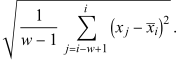
The moving standard deviation of a time series  is the sequence obtained by computing a standard
deviation in each consecutive window of a fixed width
is the sequence obtained by computing a standard
deviation in each consecutive window of a fixed width  . For the window ending at index
  , the sample moving standard deviation, for
  , is
, is
 |  |  |
(1)
|
 |  |  |
(2)
|
Using  instead of
  in the denominator gives the population convention. Boundary conventions may omit
the first
in the denominator gives the population convention. Boundary conventions may omit
the first  positions, shorten the initial windows, or pad the data, so they must be specified
when implementations are compared.
positions, shorten the initial windows, or pad the data, so they must be specified
when implementations are compared.
The moving standard deviation is also called the moving deviation or running standard deviation. It describes local variability in the same way that a moving average describes local level. It should not be confused with a single standard deviation computed from an entire data record.
In particular, the mdev value reported by the Linux ping utility is not a moving-window deviation. It is the population standard
deviation of all the round-trip times in the report, corresponding to the denominator
 above when the window is the full record (iputils Project).
