

The McEliece-Rodemich-Rumsey-Welch (MRRW) bound is an asymptotic upper bound for the rate  of a binary code of
relative minimum distance
of a binary code of
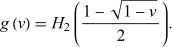
relative minimum distance  . Define the binary entropy function and an auxiliary function
by
. Define the binary entropy function and an auxiliary function
by
 |
(1)
|
with  . For
. For  , define
 |
(2)
|
The first MRRW exponent is
 |
(3)
|
and the optimized second MRRW exponent is
 |
(4)
|
For  , the classical bound is
  (McEliece et al. 1977).
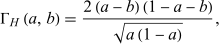
OpenAI (2026) enlarged the two classical variational families as follows. For  ,
set
,
set
 |
(5)
|
and
 |
(6)
|
For parameters
 |  |  |
(7)
|
 |  |  |
(8)
|
define
 |  |  |
(9)
|
 |  |  |
(10)
|
 |  |  |
(11)
|
 |  |  |
(12)
|
 |  |  |
(13)
|
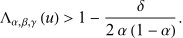
Let  be the set of quadruples
  satisfying these ranges and
 |
(14)
|
The constant-weight exponent is
![kappa_(CW)(delta)=inf_((alpha,beta,gamma,u) in D_delta)[1-H_2(alpha)+H_2(u)-alphaH_2(beta/alpha)-(1-alpha)H_2(gamma/(1-alpha))].](/images/equations/McEliece-Rodemich-Rumsey-WelchBound/NumberedEquation8.svg) |
(15)
|
Finally, the new binary-code exponent is
 |
(16)
|
and OpenAI proved
 |
(17)
|
The comparison is strict for every fixed  in this interval. The boundary choices
  and
and  recover the classical
  and constant-weight families. Positive harmonic degrees
strictly improve every interior minimizing layer; when the endpoint
and constant-weight families. Positive harmonic degrees
strictly improve every interior minimizing layer; when the endpoint  minimizes
  , so that
  , the whole-cube family instead gives the strict improvement.
