


The maximum distinct differences problem asks for the largest number  of distinct positive differences
determined by a
 -element subset of the integers
0, 1, ...,
 ,
where
 is a nonnegative integer and
 . Explicitly,
 |
(1)
|
where the maximum is over the stated  -element subsets. Pikhurko and Schoen
(2007, pp. 1-2) use
 for the largest cardinality
of
 ,
including zero and both signs, so
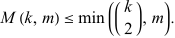
 . The number of unordered pairs and the available
differences give
 |
(2)
|
Attaining the first bound requires all pairwise differences to be distinct, as in a Golomb ruler. Attaining the second requires every
distance from 1 through  to occur. A sparse ruler minimizes
the number of marks needed for that complete coverage, whereas this problem fixes
the number of marks and maximizes the number of distances attained.
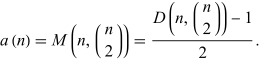
A sequence of particular interest takes  , where the two elementary bounds agree,
 |
(3)
|
Beginning with  , the recorded values are 3, 6, 9, 13, 19, 26, 32, 40, 49,
58, 68, 79, ... (OEIS A399997). This sequence
was a runner-up in the OEIS 400K celebration contest (OEIS Foundation Inc. 2026).
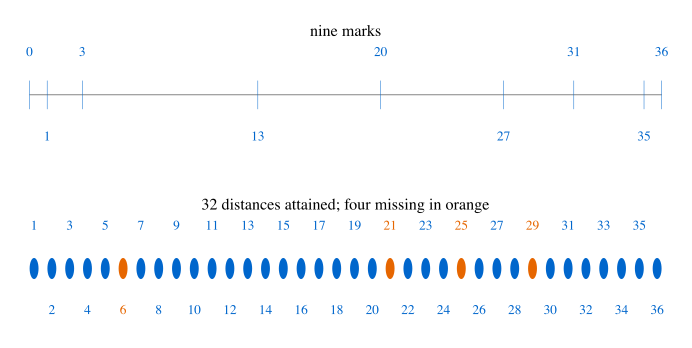
For  ,
the marks
 0,
1, 3, 13, 20, 27, 31, 35, 36
 attain 32 distances, missing only 6, 21, 25, and 29 (Pegg 2026).
Adding a mark at 6 gives all 36 distances, illustrating the distinction between maximizing
partial coverage and requiring complete coverage. Pegg (2026) also supplies larger
constructions. For example, his 15-mark construction attains 90 distinct positive
differences and therefore establishes
 , with equality conjectural.
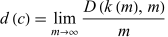
For any fixed  , Pikhurko and Schoen (2007, pp. 3-4) proved that
 |
(4)
|
exists whenever  , independently of the choice of the integer-valued function
 .
Here
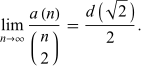
 denotes a quantity tending to zero. Consequently, the special sequence
satisfies
 |
(5)
|
This limit concerns asymptotic density and does not establish exact finite values.

 Pegg, E. Jr. "Winners of the OEIS 400K Milestone Contest."
Wolfram Community. Oct. 26, 2026.