

The max-flow min-cut theorem equates the maximum value of an  -
- network flow with the minimum
capacity of an
network flow with the minimum
capacity of an  -
- cut in a directed
graph. Let
cut in a directed
graph. Let  be a directed network flow graph with source
  ,
sink
,
sink  , and nonnegative edge capacities
  .
An
.
An  -
- flow
flow  assigns each graph edge a value
satisfying
assigns each graph edge a value
satisfying  and conserves flow at every graph
vertex other than
and conserves flow at every graph
vertex other than  and
and  . Its value
  is the net amount leaving
  .
.
An  -
- cut is a partition
  with
with  and
and  . Its capacity is the
sum of the capacities of the
edges directed from
. Its capacity is the
sum of the capacities of the
edges directed from  to
to  . With these definitions,
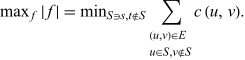 |
Thus every cut gives an upper bound on the value of a flow, and there is always a flow and a cut attaining the same value (Ford and Fulkerson 1962; Skiena 1990, p. 178).
The theorem underlies the augmenting path method: when the residual network contains no path from  to
to  , the vertices reachable from
 determine a minimum cut. If all capacities
are integers, a maximum flow
can be chosen with integer values on every graph
edge.
determine a minimum cut. If all capacities
are integers, a maximum flow
can be chosen with integer values on every graph
edge.
