

A matroid prophet inequality is a prophet inequality in which the accepted elements must form an independent set of a known finite matroid  .
For a vector of nonnegative
values
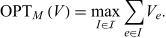
 , the offline benchmark is
 |
The online rule decides irrevocably whether to accept each arriving element.
OpenAI (2026) reports a measurable rule using one independent sample  from each element's value statistical
distribution before arrivals. The random variables
 and
 are mutually independent across all elements and draws, with each
 having the law of its own
 . The rule uses the samples and the arrival history
without knowing the value laws. If the offline optimum has finite expectation
value, the claimed guarantee for the accepted set
 is
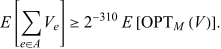 |
The bound is claimed even when the order of arrival is chosen after seeing the samples, values, value laws, and the rule's random seed. The AI-generated proof gives a measurable rule without a polynomial time bound.
Abdi et al. (2026) consider an order unknown to the rule and fixed independently of the samples, values, and the rule's randomness. With independent nonnegative values
and one independent sample from each value's statistical
distribution, their algorithm is reported to attain
the optimal guarantee of half the expectation value
of the offline optimum, using  independence queries for a known matroid
with
 elements. They credit GPT Astra and GPT Sol 5.6 with assistance in deriving the algorithm and its guarantee.
