

Mathematical induction is a method for proving that a proposition  holds for every integer
  . The base case establishes
  . For the inductive step, one assumes
 ,
called the induction hypothesis, for an arbitrary integer
,
called the induction hypothesis, for an arbitrary integer  and proves
  . The principle
of mathematical induction then implies that
. The principle
of mathematical induction then implies that  holds for every
  .
.
For example, consider the identity
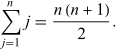 |
The base case  is immediate. If the identity holds for
  , then
 |
which proves the inductive step.
Ordinary mathematical induction uses the principle of weak induction. Under the principle
of strong induction, the induction hypothesis assumes  for every
  from
from  through
  , while transfinite induction
extends the method from the integers to well-ordered
sets.
, while transfinite induction
extends the method from the integers to well-ordered
sets.
