

Lucas's root theorem, also called the Gauss-Lucas theorem, states that the zeros of the derivative of a nonconstant complex polynomial lie in the convex hull of the zeros of the original polynomial (Lucas 1874). Iterating the result shows that the zeros of every higher derivative lie in the same convex hull.
Indeed, if
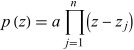 |
and  is a zero of
  that is not already a zero of
  , then
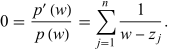 |
Taking complex conjugates and rearranging expresses  as a convex combination of the
  , with positive weights proportional to
  . Thus
  belongs to their convex hull
(Marden 1966).
belongs to their convex hull
(Marden 1966).
The Sendov conjecture is a sharper root-by-root localization. When all zeros of a polynomial lie in the closed unit disk, it places a critical point within distance 1 of every zero, whereas Lucas's root theorem only places all critical points in their common convex hull.
