

The lollipop problem asks for the maximum number  of regions into which
 lollipops can divide the plane.
Here
 is a nonnegative integer, and a lollipop consists
of a circle and a ray starting
at a point on the circle and
extending radially outwards, away from the center. The
radii and orientations may vary (Cutler et al. 2026,
p. 43; Numberphile 2026).
To maximize the number of regions, it suffices to consider a generic arrangement: there are no tangencies, no triple crossings, and no crossing
at the attachment of a ray to its own circle.
If  counts the crossings between distinct lollipops, the number of regions
in such an arrangement is
 |
(1)
|
Two lollipops have at most seven crossings: two between their circles, two for each ray with the other circle, and one between their rays. Consequently,
 |
(2)
|
The upper-bound values form OEIS A389608, indexed from  .
Equality holds for
 ,
but
 rather than 47 (Cutler et al. 2026, pp. 43-46).
The values of  begin 1, 2, 10, 25, 45, 71, 104, 142, 186, 237, ... at
 (OEIS A389624). Mahajan
and Chopra (2026, p. 2) establish exact values through
 and at
 , with
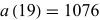 . They give
 and
 . The finite-case proof work used AI
assistance (Cutler et al. 2026, p. 47). The general maximum remains unresolved.
The AI-derived candidate for a general solution described by Cutler et al. (2026,
p. 47) is explicitly unconfirmed.
If all lollipops have the same radius, the maximum is instead
 |
(3)
|
where  is the ceiling function (Paulsen). Its initial
values are 1, 2, 10, 25, 44, 70, 103, 140, ... at
 (OEIS A396714). Thus
allowing different radii already changes the answer for
four lollipops.
