TOPICS
Search

Logit Transformation


LogitTransformation

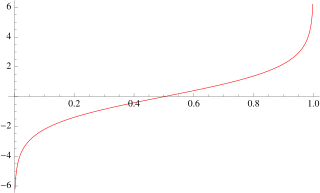
The logit transformation applies the logit function f(x)=logit(x) to map a probability x in (0,1) to its log-odds. In logistic regression, the log-odds of the conditional probability of success are a linear function of the explanatory variables. For two probabilities p_0 and p_1 in (0,1), the difference of the transformed values is the natural logarithm of the odds ratio,

 f(p_1)-f(p_0)=ln((p_1(1-p_0))/(p_0(1-p_1))).
(1)

The transformation has an inflection point at x=1/2, where its second derivative

 f^('')(x)=(2x-1)/(x^2(1-x)^2)
(2)

changes sign.

The transformation has also been used to generate random numbers from the logistic map x_(n+1)=4x_n(1-x_n) (Collins et al. 1992). If the initial value is drawn from a stationary distribution of the map with probability density function 1/(pisqrt(x(1-x))) for 0<x<1, each transformed value z=f(x_n) has probability density function


 P_Z(z)=1/(pi(e^(z/2)+e^(-z/2)))
(3)

for z in R. Collins et al. (1992) describe this density as close to that of a normal distribution. Successive values are dependent because each value determines the next.


See also

Logistic Map, Logistic Regression, Logit Function, Odds Ratio

Explore with Wolfram|Alpha

References

Collins, J. J.; Fanciulli, M.; Hohlfeld, R. G.; Finch, D. C.; Sandri, G. v. H.; and Shtatland, E. S. "A Random Number Generator Based on the Logit Transform of the Logistic Variable." Computers in Physics 6, 630-632, 1992. https://doi.org/10.1063/1.168442.Pickover, C. A. Keys to Infinity. New York: Wiley, pp. 244-245, 1995.

Referenced on Wolfram|Alpha

Logit Transformation

Cite this as:

Weisstein, Eric W. "Logit Transformation." From MathWorld--A Wolfram Resource. https://mathworld.wolfram.com/LogitTransformation.html

Subject classifications