

A log contrast of a positive vector  is a linear
combination of natural logarithms of its
components of the form
is a linear
combination of natural logarithms of its
components of the form
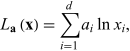 |
where the coefficients  are real numbers satisfying
 . The zero-sum condition
makes the value unchanged when every component is multiplied by the same positive
constant, since
. The zero-sum condition
makes the value unchanged when every component is multiplied by the same positive
constant, since
 |
for every  .
Equivalently,
.
Equivalently,  ,
so the log contrast depends only on ratios among the components.
For example, choosing
,
so the log contrast depends only on ratios among the components.
For example, choosing  ,
,
 , and
, and  for
for  gives
gives  .
.
For compositional data, a linear regression model with compositional independent
variables can be written  , where
  . The zero-sum restriction makes the fitted value independent of the total to which the components
are normalized.
. The zero-sum restriction makes the fitted value independent of the total to which the components
are normalized.
