

Let  ,
,
 ,
...,
,
...,  be vectors in a vector space
  over a field
  . They are linearly dependent iff there
exist scalars
. They are linearly dependent iff there
exist scalars  ,
,  , ...,
  in
in  , not all zero, such that
 |
(1)
|
If no such scalars exist, then the vectors are said to be linearly independent.
If  is
is  -dimensional,
choose a vector basis and let
-dimensional,
choose a vector basis and let  be the
  th coordinate of
  . The condition for linear
dependence is then
. The condition for linear
dependence is then
![c_1[x_(11); x_(21); |; x_(n1)]+c_2[x_(12); x_(22); |; x_(n2)]+...+c_n[x_(1n); x_(2n); |; x_(nn)]=[0; 0; |; 0]](/images/equations/LinearlyDependentVectors/NumberedEquation2.svg) |
(2)
|
![[x_(11) x_(12) ... x_(1n); x_(21) x_(22) ... x_(2n); | | ... |; x_(n1) x_(n2) ... x_(nn)][c_1; c_2; |; c_n]=[0; 0; |; 0].](/images/equations/LinearlyDependentVectors/NumberedEquation3.svg) |
(3)
|
This matrix equation has a nontrivial solution iff its determinant is 0. Thus, in this  -dimensional setting, the vectors
are linearly dependent iff
-dimensional setting, the vectors
are linearly dependent iff
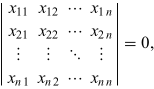 |
(4)
|
and linearly independent otherwise.
Let  and
and  be vectors in
  , equipped with the standard dot
product. Then the following three conditions are equivalent (Gray 1997).
, equipped with the standard dot
product. Then the following three conditions are equivalent (Gray 1997).
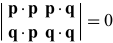
1.  and
and  are linearly dependent.
2. 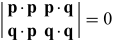 .
.
3. The  matrix
 ![[p; q]](/images/equations/LinearlyDependentVectors/Inline23.svg) has matrix rank less than
two.
has matrix rank less than
two.
