

Linear growth, in the sense of asymptotic notation, means that an eventually positive real-valued
function  satisfies
 as
 tends to infinity,
using big-theta notation. Equivalently, there
exist positive constants
 ,
 , and
 such that
 |
for all  (Cormen et al. 2001, p. 42). The same definition applies to a sequence
 as
 .
Every linear function  with
 has linear growth. The stronger condition
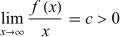 |
also implies linear growth, but the converse fails. For example,  satisfies
 for
 , while its ratio to
 has no limit as
 .
Superlinear growth instead requires  . A linear time
bound
 supplies only an upper bound and does not by itself
imply linear growth in this two-sided sense.
