

Lasso regression, where "lasso" abbreviates least absolute shrinkage and selection operator, is a regression method that adds
a penalty based on the  norm to a least squares
fitting objective. For a response vector
norm to a least squares
fitting objective. For a response vector  , design matrix
  , and coefficient vector
  , a common form is
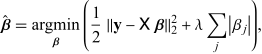 |
where  controls the amount of regularization (Tibshirani 1996).
When  ,
the criterion reduces to least squares fitting.
Increasing
,
the criterion reduces to least squares fitting.
Increasing  shrinks coefficients toward zero, and some coefficients
may become exactly zero. The method therefore performs variable selection as well
as estimation. The objective function is a
convex function, so it is a problem in convex
optimization theory.
shrinks coefficients toward zero, and some coefficients
may become exactly zero. The method therefore performs variable selection as well
as estimation. The objective function is a
convex function, so it is a problem in convex
optimization theory.
