TOPICS
Search

Lami's Theorem


Lami's theorem relates three nonzero, coplanar force vectors that are not all collinear and act at a common point in equilibrium. If F_1+F_2+F_3=0 and alpha_i is the angle between the other two force vectors, then

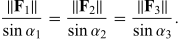
 (||F_1||)/(sinalpha_1)=(||F_2||)/(sinalpha_2)=(||F_3||)/(sinalpha_3).

The result follows from the law of sines applied to the triangle formed by placing the three vectors successively head to tail. Each interior angle of this triangle is supplementary to the corresponding alpha_i, and supplementary angles have equal sines.


See also

Angle, Law of Sines, Triangle, Vector

Explore with Wolfram|Alpha

References

Shrimati Indira Gandhi College, Department of Mathematics. "Forces." Statics, Unit I, pp. 11-12. https://www.sigc.edu/sigc/department/maths/studymet/Forces.pdf.

Cite this as:

Weisstein, Eric W. "Lami's Theorem." From MathWorld--A Wolfram Resource. https://mathworld.wolfram.com/LamisTheorem.html

Subject classifications