


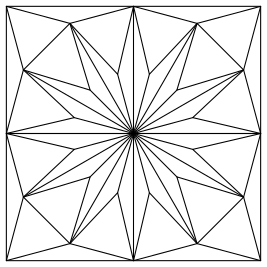
Kűrschák's tile is an attractive tiling of the square composed of two types of triangular tiles. It consists of 16 equilateral
triangles and 32  -
- -
- isosceles triangles
arranged in the shape of a dodecagon.
isosceles triangles
arranged in the shape of a dodecagon.
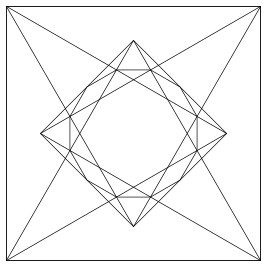
The composition of Kürschák's tile is motivated by drawing inward-pointing equilateral triangles on each side of a unit square and then connecting adjacent vertices to
form a smaller square rotated  with respect to the original square.
Joining the midpoints of the square together with the intersections of the equilateral
triangles then gives a dodecagon (Wells 1991) with
circumradius
with respect to the original square.
Joining the midpoints of the square together with the intersections of the equilateral
triangles then gives a dodecagon (Wells 1991) with
circumradius
 |
