

Kotani's ant problem asks for the point on the surface of a  rectangular box that is farthest, by surface geodesic distance, from a specified vertex.
The farthest point is not the opposite vertex.
It lies on the
rectangular box that is farthest, by surface geodesic distance, from a specified vertex.
The farthest point is not the opposite vertex.
It lies on the  face opposite the starting vertex,
one-quarter of the way along a diagonal from the corner
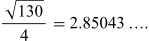
farthest from the starting vertex. Its distance
from the starting point is
face opposite the starting vertex,
one-quarter of the way along a diagonal from the corner
farthest from the starting vertex. Its distance
from the starting point is
 |
The result is obtained by unfolding the relevant faces of the box into the plane. At the maximizing point, four different unfolded line segments from the starting vertex have the same length; moving away from that point shortens at least one of them. The problem was proposed by Yoshiyuki Kotani and publicized by Gardner (1996).
Like the spider and fly problem, Kotani's ant problem compares straight-line distances in planar unfoldings of a rectangular box. The spider and fly problem fixes both endpoints and minimizes the path between them, whereas Kotani's problem fixes one endpoint and asks which second endpoint is farthest from it.

 ." Math Horizons 3, 8-9, 1996.