


A Koch curve is the fractal curve obtained by starting with a line segment, replacing its middle third by the two other sides of an equilateral triangle, and repeating this replacement on every resulting line segment. At each step, the triangular protrusion is placed to the left when the line segment is traversed from the first endpoint to the second. The limit is a continuous curve with no tangent line at any point (Koch 1904, pp. 684-695). Three suitably rotated copies form the boundary of a Koch snowflake.
For an initial line segment of length 1, the  th polygonal approximation consists of
 segments of length
 and has total length
 , where
 |  |  |
(1)
|
 |  |  |
(2)
|
 |  |  |
(3)
|
Thus its length tends to infinity as  , and the limiting curve has infinite arc
length.
In the complex plane, normalize the endpoints to 0 and 1 and the first protrusion to lie above the real axis. The curve is the attractor of an iterated function system of four similarities,
 |  |  |
(4)
|
 |  |  |
(5)
|
 |  |  |
(6)
|
 |  |  |
(7)
|
Each map reduces distances by a factor of  . The Koch curve is the unique
nonempty compact set
 satisfying
 |
(8)
|
This gives its exact self-similarity (Hutchinson 1981). Its Hausdorff dimension and capacity dimension are both
 |
(9)
|
A Lindenmayer system for its polygonal approximations has axiom "F", string rewriting
rule "F" -> "F+F--F+F", and turning angle  . The
 th approximation is implemented in the Wolfram
Language as KochCurve[n].
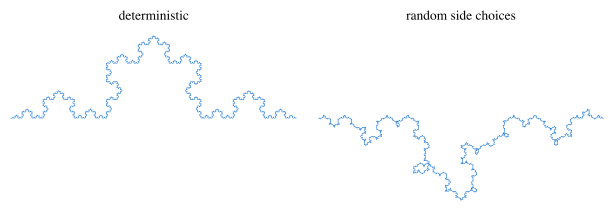
A random von Koch curve is obtained by independently choosing, with equal probability, which side of each removed middle-third segment receives the new equilateral
triangle. Its rescaled pieces have the same statistical
distribution, giving a statistical form of self-similarity.
The resulting curve has Hausdorff dimension  , the same as the ordinary Koch
curve (Falconer 2003, pp. 244-245 and 256).
